

Part of these collections
Leer en español: Enseñe a los niños que no tienen que defenderse por sí mismos
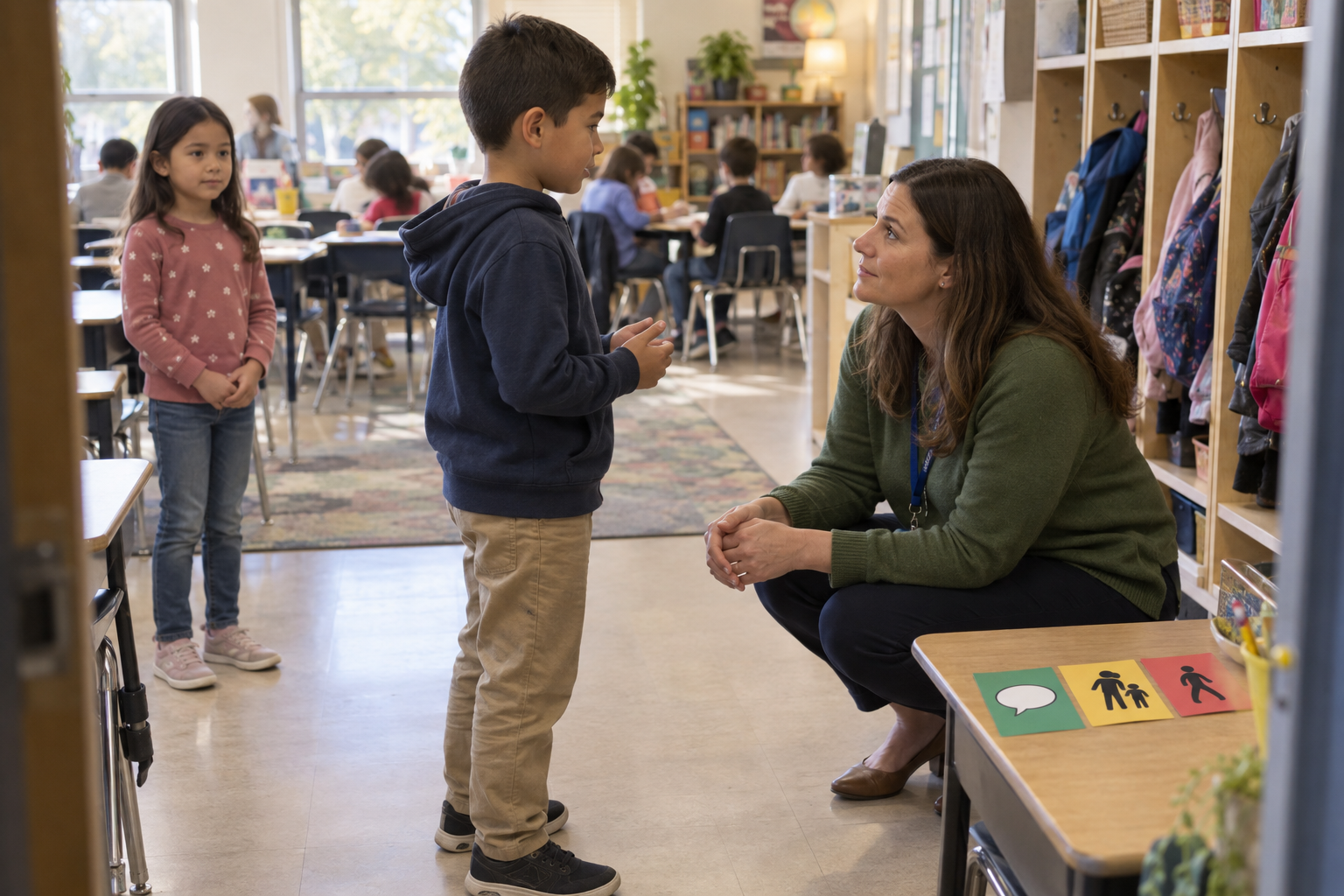
Helping students respond to peer provocation begins with teaching them that adults can be trusted to protect them.
One of the most difficult things we ask children to do in classrooms is to ignore another child who is intentionally trying to provoke them. We ask them not to respond when another student calls them stupid, says something about their mother, or brings up something embarrassing that happened in the past. We expect them to keep their voices calm, use kind words, and continue doing what they are supposed to be doing.
But ignoring someone who is intentionally trying to make you angry is genuinely difficult. It is difficult for children, and it is difficult for adults. And if we are going to ask children to do something that difficult, we have a responsibility to teach them how to do it and to make sure that doing it is worthwhile.
In classrooms where students have a history of serious behavior problems, these situations may occur frequently. Students may have learned to provoke one another, to respond aggressively when provoked, or to defend themselves because they have not always been able to depend on adults to intervene. And when several students begin responding to one another’s behavior, a relatively small problem can quickly become a much larger one.
The strategies needed to respond to these situations must begin long before the situations happen. [3][2]
When Students Feel They Have to Defend Themselves
When students continually defend themselves against the provocations of their peers without allowing adults the opportunity to intervene on their behalf, it may be an indication that the adults have not consistently done so in the past.
Perhaps the adults have missed opportunities to step in and ensure that students are supported. Perhaps unkind behaviors have been ignored or handled as though they were relatively unimportant. And over time, students may have learned that if they don’t defend themselves, nobody else will.
I think this is something that teachers need to consider carefully. Sometimes we look at a student who reacts aggressively to being provoked and focus almost entirely on that student’s response. But we also need to consider what happened before the response and whether the student has good reasons to believe that the adults will protect them.
In classrooms where students don’t trust adults to intervene, the environment can feel as though it is constantly on the verge of boiling over. Students are watching one another, anticipating the next insult or provocation, and preparing to defend themselves. Even relatively minor disagreements can escalate quickly.
And when a classroom operates this way, it is very difficult to make learning happen.
The solution is not simply to tell students to stop reacting. We have to demonstrate, consistently, that the adults are paying attention, that unkind behavior matters, and that students can depend on us to intervene. [4][1]
Teaching Students to Ignore and Move On
When you are working with students who tend to react to one another’s problem behavior, or who tend to respond negatively when provoked to anger by a peer, you have to teach them early and often how to ignore those provocations and move in a positive direction behaviorally.
One way we do this is by valuing the behavior of students who are able to ignore another student’s misbehavior. We show them that one of the things we value more than almost anything else in our classroom is a student who is able to keep doing what they are supposed to be doing and trust that the adults can take care of them.
But in order to convince a student that they do not need to defend themselves against the verbal attacks or other provocations of another student, you need to demonstrate that you will consistently defend them.
That is an important distinction. We cannot simply tell a student to ignore someone who is bothering them and then leave them to manage the situation on their own. If we expect children to trust us, we have to give them good reasons to trust us.
This means responding consistently to the behavior of the student who is doing the provoking. It also means using our reinforcing strategies to recognize and reward the student who is making the difficult choice not to respond. [2]
Give Students Words They Can Use
One of the ways we can help students learn to respond appropriately to provocation is by giving them words they can use when another student says something unkind.
I often suggest simple statements like:
- “That’s not nice.”
- “That’s unkind.”
- “I don’t like that.”
Now, these may sound like unusual things for a child to say when another student is deliberately trying to provoke them. But that’s part of what makes them useful.
They are relatively unreactive. They don’t escalate the situation, and they don’t provoke the other student in return. They allow the student to acknowledge that something unkind has happened without getting into an argument or responding with another insult.
And sometimes the best response is simply not to respond at all, but instead to seek help from an adult. [1]
The important thing is that we teach students what they can do rather than simply telling them what they shouldn’t do. We can practice these responses before difficult situations occur, so that when a student is provoked, they have already learned some alternatives to becoming angry and defending themselves aggressively. [3]
Preparing Students Before Provocation Occurs
In classrooms where these situations happen frequently, teachers often have opportunities to predict when a student is likely to be provoked. Rather than waiting for the situation to occur, we can prepare the student beforehand.
For example, I might say:
“Hey, when Tommy decides to call you a name today, I’m going to look at you, and I want you to ignore whatever Tommy says. Be very careful to keep your voice and the words that you say kind. One thing you can do is say, ‘Mr. Peter, can I have some help, please?’
“It is my job to address Tommy’s behavior. It is not your job to do that.”
This is an opportunity to explain what we expect the student to do, but it is also an opportunity to explain what the student can expect from us.
Sometimes the Teacher Needs to Apologize
At this point, you may even need to apologize to the student.
You might say:
“I’m sorry if anything I have done has made you feel like you have to defend yourself against the attacks of another student. That is something I never want you to feel in this classroom.
“I promise that I will do my part when Tommy starts provoking you. I will talk with Tommy, but in the meantime, I need you to help me by making sure that you don’t respond to him. If you respond to Tommy, you’re taking away the opportunity for me to do the job I’m trying to do to help Tommy, but also to help you.”
And then we explain that when the student is able to ignore the provocation, we are going to recognize that effort.
They may earn positive points in a classroom reinforcement system. They may have opportunities to earn rewards or receive recognition. We want to celebrate that effort because we recognize that what we are asking the student to do is difficult.
But the points and rewards are only part of what makes this work. The more important part is that the student begins to learn, through experience, that the adults in the classroom can be trusted.
What Happens When We Fail?
There is another important part of this conversation, and I think it is one that teachers sometimes overlook.
We need to give students permission to tell us when we have failed to do what we promised.
I might tell a student:
“If a situation happens and I do not come to defend you, I want you to come and talk to me about that. I want you to say, ‘Mr. Peter, you told me that when another student provoked me, you would come to my defense and I wouldn’t have to do it myself. Today that student threw a pencil, and it hit me in the face.’
“I want you to tell me about that. I want the opportunity to apologize to you personally, and I want the opportunity to know that I failed so that I can do better going forward.”
Of course, if a student is being physically threatened or hurt, we want them to protect themselves by moving away, seeking help, and following the safety procedures we have taught them. Ignoring a provocation should never mean remaining in danger.
But there is a larger lesson here that goes beyond how to respond to another student’s behavior.
When we invite children to tell us that we have made a mistake, and when we respond to that conversation with humility and a genuine desire to do better, we are modeling exactly the kind of spirit and attitude that we want them to develop in their own lives.
We are not trying to pretend that we are perfect and they are not. We are not teachers because we never have problems, never lose our temper, or never find ourselves tempted to do something we are not supposed to do.
Rather, we do our best, and when we make a mistake, we go to the person we have hurt and say we are sorry. We ask for forgiveness. We learn to confront someone who has hurt us without hurting them in return.
We want to model that kind of civility in our classrooms.
And when we do, we are teaching something much more important than simply getting children to ignore one another. We are teaching them that relationships can be repaired, that adults can be trusted, and that they do not have to handle every difficult situation on their own.
References
- Eliot, M., Cornell, D., Gregory, A., & Fan, X. (2010). Supportive school climate and student willingness to seek help for bullying and threats of violence. Journal of School Psychology, 48(6), 533–553. https://doi.org/10.1016/j.jsp.2010.07.001
- Simonsen, B., Fairbanks, S., Briesch, A., Myers, D., & Sugai, G. (2008). Evidence-based practices in classroom management: Considerations for research to practice. Education and Treatment of Children, 31(3), 351–380. https://doi.org/10.1353/etc.0.0007
- De Pry, R. L., & Sugai, G. (2002). The effect of active supervision and pre-correction on minor behavioral incidents in a sixth grade general education classroom. Journal of Behavioral Education, 11(4), 255–267. https://doi.org/10.1023/A:1021162906622
- Frey, K. S., Hirschstein, M. K., Snell, J. L., Edstrom, L. V. S., MacKenzie, E. P., & Broderick, C. J. (2005). Reducing playground bullying and supporting beliefs: An experimental trial of the Steps to Respect program. Developmental Psychology, 41(3), 479–490. https://doi.org/10.1037/0012-1649.41.3.479