

Part of these collections
Leer en español: Más de un idioma
Supporting communication and learning in multilingual families
Many of the children we serve in applied behavior analysis grow up in homes where the primary language is different from the language spoken at school or in therapy.
A child might hear Spanish at home and English at school. Another child might hear Nepali, Arabic, Burmese, or another language when interacting with parents and extended family members, while most of their formal instruction takes place in English.
Sometimes these children are learning to communicate in two languages at the same time. Sometimes they have significant language delays and are still developing basic communication skills in either language.
When we encounter these situations, it is important to remember that our goal is not simply to teach children to speak English. Our goal is to help them communicate meaningfully with the people in their lives.
The Language of Home
I try always to encourage parents to continue using the language they naturally speak at home with their children.
If parents are most comfortable speaking Spanish, Nepali, Arabic, or another language, I see no reason that they should feel obligated to abandon that language simply because their child is receiving therapy or attending school in the United States. It is their home, after all. Their child is likely to hear that language throughout family life, and understanding it may be important for relationships with parents, grandparents, siblings, and extended family members.
There are people who believe that children living in the United States should speak only English and that parents should therefore communicate with their children exclusively in English. I disagree with that approach.
If learning English would be useful to the parents, they may certainly choose to learn it. And if they want to teach their child English, we should support that goal as well. But I would not encourage parents to neglect opportunities to expose their children to the language that is most natural to their family. For many families, the home language is an important part of maintaining relationships, traditions, and connections across generations. We should not ask families to sacrifice those connections unnecessarily.
Affirming What the Child Already Knows
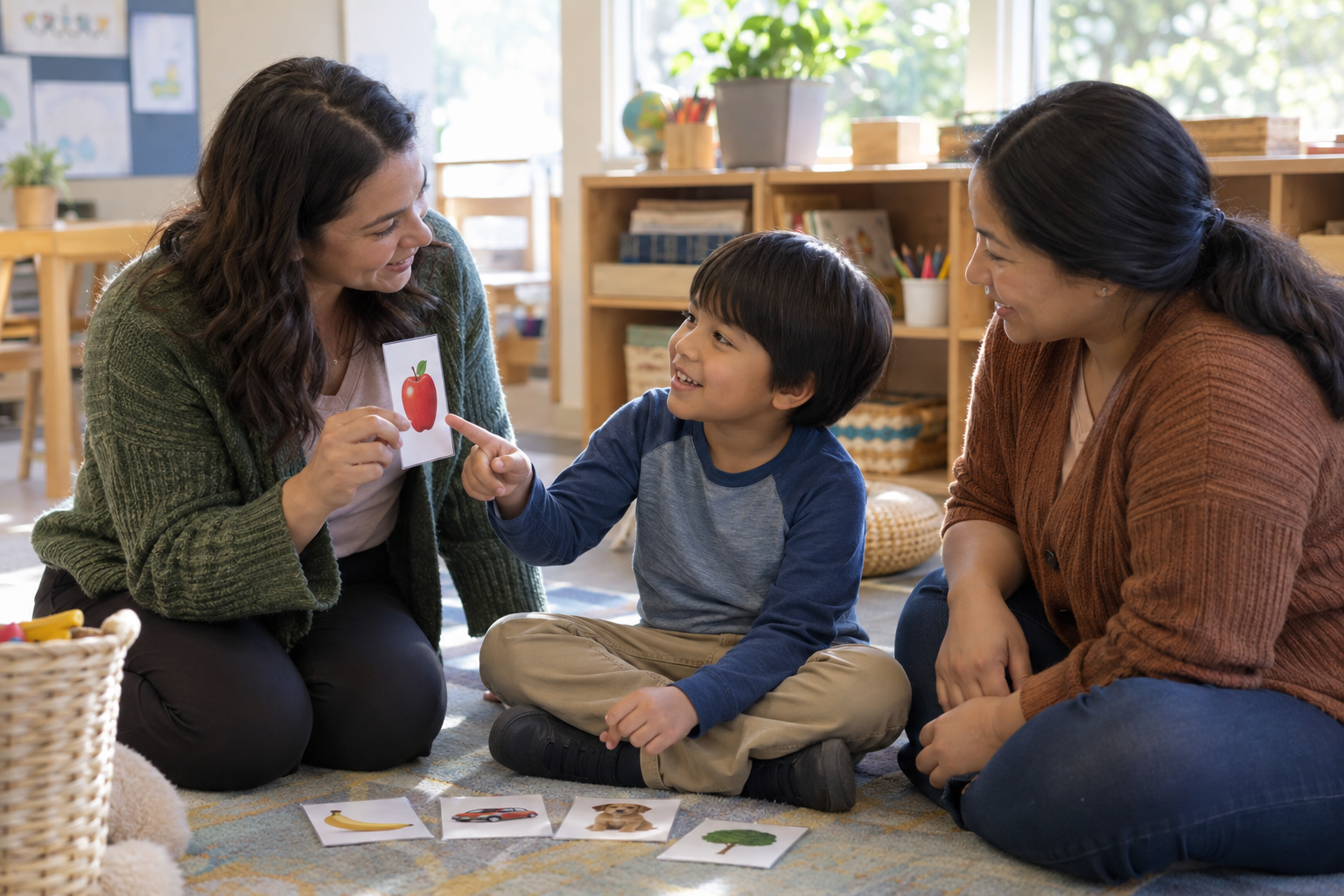
One of the practical things I encourage teachers and therapists to do is to incorporate familiar words from the child's home language into instruction whenever it is appropriate and helpful.
I see opportunities for this frequently at our clinic. We have a number of children who speak Spanish at home, and although I am not particularly good at speaking Spanish, I know quite a few Spanish words.
Sometimes I will ask a child a question in English, and the child will answer in Spanish. When that happens, I affirm the answer. I don't tell the child that the answer is wrong simply because it wasn't in English.
For example, I might ask a child, "Do you want to go into the sensory room?"
The child responds, "Sí."
I say, "Okay! You can say yes."
The child says, "Yes," and we go into the sensory room.
Or I might hold up a bottle of water and ask, "What is this?"
The child says, "Agua."
I respond, "Right! You can say water."
The child says, "Water."
In both situations, I'm affirming that the child's original answer was correct. I'm simply teaching another way to say the same thing. I'm not saying that their way is wrong. I'm giving them another way as well.
And importantly, the child does not have to produce the English word in order for the original communication to be meaningful. We can acknowledge and honor what the child has communicated while also providing an opportunity to learn additional vocabulary.
Building Associations Across Languages
Language involves relationships between sounds, symbols, experiences, and meanings. When a child learns that agua and water can refer to the same thing, they have another opportunity to build an association between a word and its meaning.
We can also incorporate these associations into visual communication systems. For example, when developing a Picture Exchange Communication System (PECS) or other picture-based communication materials, it may be helpful to include both the child's home-language word and the English equivalent. A picture of water might have agua and water written beneath it. A picture of a familiar family member might include the name or word that the child actually uses for that person.
These decisions should be individualized, of course. The words printed on a picture may be more useful to the adults supporting communication than to a child who is not yet reading. And the design of any formal communication system should be coordinated with the professionals responsible for the child's communication intervention.
But the larger point is that we can make room for both languages. We can teach English without discouraging the language the child already knows.
Using the Words Children Use at Home
This extends beyond teaching vocabulary for objects.
At our clinic, we often ask families to provide pictures of the important people in their child's life so that we can help the child learn to recognize, identify, and talk about them. But we also need to know what the child calls those people.
We cannot assume that every child uses the words mom, dad, grandmother, aunt, or uncle. Families may use different words based on their language, culture, or family traditions. If a child calls their grandmother by a particular name, that is the name we should be using when teaching the child to identify her. These are not insignificant details. They make instruction more relevant to the child's actual life.
Making Parent Materials Accessible
We also try to develop as many of our parent materials as possible in the family's preferred language. This includes handouts, instructional materials, data sheets, and other documents that parents may use to support their child's learning.
There is no reason that a data sheet must be written in English in order for it to work. If we are asking parents to record a number, mark whether a behavior occurred, or track a particular skill, the instructions should be in a language they can understand comfortably. This shouldn't be rocket science.
We have access to increasingly useful translation tools, and we should take advantage of them while making sure that important translations are accurate. For complex discussions, treatment decisions, and informed consent, we should use qualified interpreters or other appropriate language support rather than relying on an unverified automated translation. At our clinic, we are fortunate to work with excellent Spanish interpreters who understand autism, behavior analysis, and the terminology we use in our work. That familiarity makes a tremendous difference.
English Matters, Too
Supporting the home language does not mean that we should neglect opportunities to teach English.
For children attending English-speaking schools or living in predominantly English-speaking communities, understanding and using English may provide important opportunities for communication, participation, and independence. We should help children develop those skills when they are meaningful and appropriate.
But teaching English and supporting the home language are not competing goals. A child may benefit from being able to request something in English at school and in Spanish at home. A child may learn to recognize the same object or action when described in either language.
The important question is not which language we prefer. It is which communication skills will be most useful to the child in the environments where they live, learn, and interact with others.
The Larger Goal
Our purpose is to help children communicate with the people who matter to them.
If we teach a child to communicate successfully with therapists but fail to support communication with parents, siblings, or grandparents, we may have overlooked something tremendously important. The language of the home is not an obstacle that must be overcome. It is part of the child's life and part of the environment in which meaningful communication occurs.
We should honor that reality while helping children acquire additional communication skills that will expand their opportunities in the world.
References
- Durán, L. K., Hartzheim, D., Lund, E. M., Simonsmeier, V., & Kohlmeier, T. L. (2016). Bilingual and home language interventions with young dual language learners: A research synthesis. Language, Speech, and Hearing Services in Schools, 47(4), 339-358. https://doi.org/10.1044/2016_LSHSS-15-0030
- Hoff, E., Core, C., Place, S., Rumiche, R., Señor, M., & Parra, M. (2012). Dual language exposure and early bilingual development. Journal of Child Language, 39(1), 1-27. https://doi.org/10.1017/S0305000910000759
- Scheele, A. F., Leseman, P. P. M., & Mayo, A. Y. (2010). The home language environment of monolingual and bilingual children and their language proficiency. Applied Psycholinguistics, 31(1), 117-140. https://doi.org/10.1017/S0142716409990191
- U.S. Department of Health and Human Services, Office for Civil Rights. (2003). Guidance to federal financial assistance recipients regarding Title VI prohibition against national origin discrimination affecting limited English proficient persons. https://accessiblebehavior.com/wp-content/uploads/2026/11/more-than-one-language.pdf