

Part of these collections
Leer en español: El horario es más que una imagen en la pared
How meaningful schedules and transition warnings prevent frustration before it begins
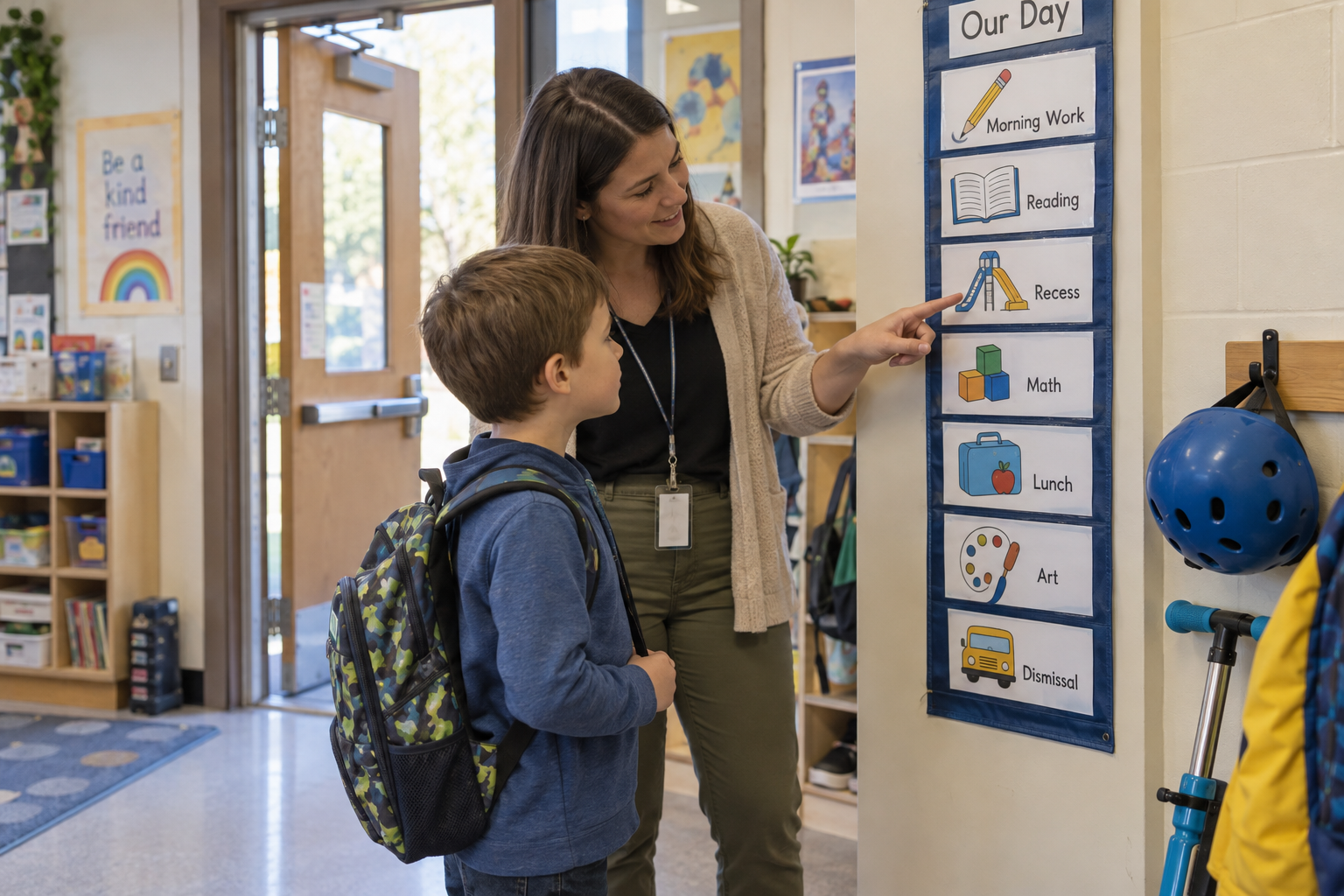
Many classrooms and therapy programs have visual schedules. They display pictures or words representing the activities children will complete throughout the day.
But there is an important difference between having a schedule and teaching a child to understand it.
A schedule that hangs on the wall, unchanged and largely ignored, may do very little to help a child anticipate what is going to happen. The pictures might be familiar to the adults, but that does not mean they communicate anything meaningful to the child.
The purpose of a schedule is not to decorate the classroom or demonstrate that the adults have a plan.
The purpose is to help the child understand her day.
Why Uncertainty Can Lead to Challenging Behavior
Imagine that a child loves riding a scooter and knows that scooter time usually happens after lunch.
One afternoon, she finishes an outdoor walk and heads toward the scooter area. She expects that her favorite activity is next.
Instead, a therapist redirects her into a classroom for a group game.
From the adult’s perspective, nothing unusual has happened. The schedule clearly says that group time comes before scooter time.
But the child may not understand that sequence. She may have associated the end of lunch or the outdoor walk with the opportunity to ride the scooter.
Suddenly, she is being taken somewhere she did not expect to go, to participate in an activity she may not understand or want.
She begins screaming.
We might describe the behavior as escape-maintained because the child is trying to avoid group time. That may be accurate, but it does not tell the whole story.
The child’s confusion may have been preventable.
A Picture Does Not Automatically Have Meaning
Suppose a schedule includes a symbol labeled “Friend Time.”
What does Friend Time mean to the child?
Does it mean playing a board game? Sitting at a table? Taking turns? Playing with toys? Listening to a story?
If the child does not understand the relationship between the symbol and the actual activity, the schedule is not providing much useful information.
We need to teach that relationship.
If Friend Time involves playing a matching game, we can show the child the actual cards. We can demonstrate what matching looks like, show where the activity will take place, and explain how long it will last.
Instead of simply saying, “It’s time for Friend Time,” we might say, “We’re going to sit at this table and match these cards. You’ll take three turns, and then we’ll go to the scooter.”
Now the child has a much clearer picture of what is expected.
Teach the Schedule Throughout the Day
One of the most useful things we can do is review the schedule repeatedly.
At the beginning of the day, we can show the child the activities that are planned. We can connect the pictures to actual materials, locations, and experiences.
Before each transition, we can return to the schedule and identify where we are.
“We just finished our walk. Now we’re going to play the game. After the game, we’ll ride the scooter.”
When an activity is completed, we can mark it finished and show what comes next.
Over time, the child may begin to use the schedule independently. She may look ahead, anticipate preferred activities, and better tolerate the less preferred activities that come first.
But that independence develops because we teach the schedule, not simply because we display it.
Transition Warnings Are Communication
A transition warning gives a child time to prepare for a change.
“We have two more minutes on the trampoline. Then we’re going inside.”
“In a minute, we’re going to put the toys away and wash our hands.”
“After this turn, the game is finished.”
These statements can be supported with pictures, timers, gestures, or demonstrations, depending on what the child understands.
A warning does not guarantee that the child will be happy about the transition. It does, however, reduce the likelihood that the change will feel sudden and unpredictable.
When children understand what is coming, they have more opportunity to prepare themselves.
Make First-Then Meaningful
First-then visuals can be particularly helpful when a child wants a preferred activity that is not immediately available.
For example:
First: Three turns of the matching game.
Then: Scooter.
The first activity should be clearly defined and appropriate for the child. The second should be something that can actually be delivered as promised.
If the child completes the first activity, we follow through promptly.
This teaches a valuable relationship: Sometimes we complete one activity before moving to another, and adults can be trusted to do what they say.
We should not use first-then as a way to make every basic need or enjoyable experience conditional on compliance. Its value lies in clarifying sequences and supporting participation, not in controlling every aspect of the child’s day.
Prepare Children for the Actual Experience
When possible, show children more than a picture.
If the next activity is painting, show the paintbrush, paper, and paint. If the activity is a matching game, demonstrate how to match the cards. If the group will be doing a craft, show an example of the finished product.
This helps the child connect abstract symbols with concrete experiences.
It also gives us an opportunity to discover misunderstandings before the activity begins.
A child may become more willing to participate when she understands what she is being asked to do.
What Happens When the Schedule Changes?
Real life does not always follow the plan. Activities run late, materials are unavailable, and unexpected events occur.
That does not make schedules useless. It makes communication about changes even more important.
We can show the child what has changed, explain the new sequence, and offer choices where possible.
“The scooter isn’t available right now. We’re going to do the swing first, and then we’ll check again.”
If the change causes disappointment, we acknowledge it. We can teach the child to communicate that she is frustrated, ask when the activity will happen, or choose an alternative.
Predictability is valuable, but so is learning how to respond when things do not go as expected.
Prevention Is Part of Behavior Intervention
When a child screams during a transition, adults often focus on what to do after the screaming begins.
But one of the most important questions is what we could have done before it started.
Did the child understand the schedule? Did we explain the activity? Did we provide a warning? Did we show what participation would look like? Did we offer appropriate choices?
These questions move our attention from reacting to behavior toward preventing unnecessary frustration.
A meaningful schedule is not simply a record of what adults intend to do. It is a communication tool that helps children understand what is happening, what is expected, and what they can look forward to next.
References
- Dees, R. L., et al. (2023). Visual Supports Brief Packet. AFIRM, Frank Porter Graham Child Development Institute, University of North Carolina at Chapel Hill. https://accessiblebehavior.com/wp-content/uploads/2026/11/schedule-is-more-than-a-picture-on-the-wall.pdf
- Dettmer, S., Simpson, R. L., Myles, B. S., & Ganz, J. B. (2000). The use of visual supports to facilitate transitions of students with autism. Focus on Autism and Other Developmental Disabilities, 15(3), 163–169. https://doi.org/10.1177/108835760001500307