

Part of these collections
Leer en español: El poder de comunicarse
When adults arrange small, safe opportunities for a child to request what they want, the child learns that their own voice—however it sounds—actually works.
—
What Is Incidental Teaching?
Incidental Teaching is a way of using what a child already wants to create a real reason for that child to communicate. It belongs to a family of approaches sometimes called naturalistic teaching or natural environment teaching. The idea is straightforward: instead of sitting a child down at a table and drilling words or sentences, you notice what the child is interested in right now, arrange a brief moment where communication is needed, support the child in making a request, and then give them what they asked for.
The key word is opportunity. You are not testing the child. You are not tricking them. You are setting up a moment where communication makes something good happen.
This is different from errorless learning. If you are helping a child trace the letter H and you guide their hand so they cannot make a mistake, that is errorless learning. It has its own purpose. Incidental Teaching is something else entirely. It starts with what the child wants, not with what the adult has planned to teach.
The High Shelf and the Clear Bin
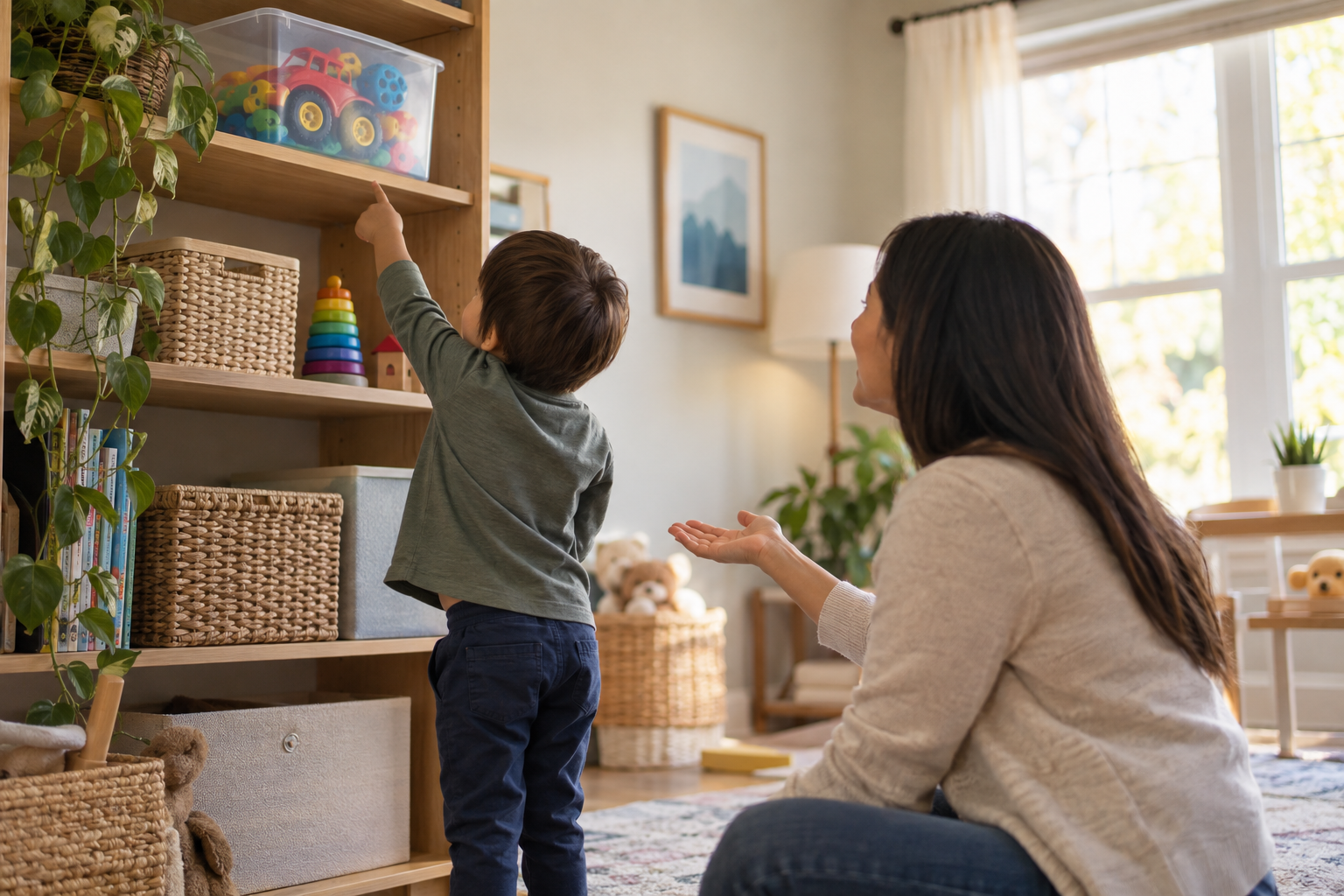
Here is a concrete example. At Accessible Hope, interesting items—toys, favorite objects, things a child lights up about—are placed in clear plastic bins on high shelves. The child can see what is up there. They know it exists. But they cannot simply grab it.
That arrangement is the whole engine. The child has a reason to communicate. They want the thing. They can see the thing. Now they need a way to tell someone.
If the adult immediately notices the child looking up and brings the item down without waiting, something important is lost. The child got what they wanted, which is good. But they did not get to practice the experience of asking and being heard. Over time, if adults always guess and never wait, the child may not develop a reliable, flexible way to say what they need—especially when the situation is harder, when they are upset, or when the adult nearby does not know them well.
This does not mean you ignore the child. It does not mean you dangle something out of reach to be cruel. It means you pause, you notice, and you help the child take one more step toward a real request.
What this is not
To be completely clear: this kind of arrangement is never appropriate for food a child needs, water, comfort, safety, medical care, or something you have already promised. You are not withholding. You are briefly arranging access to a motivating item so the child has a genuine reason to communicate, and you are standing right there, ready to help.
The Adult Pattern
Peter Beddow describes a simple sequence that adults can follow:
1. Notice what the child wants. Watch their eyes, their body, their reach. They are telling you something already.
2. Arrange a real reason to communicate. The item is visible but not within easy reach. The moment is natural, not forced.
3. Wait. Give the child a few seconds. Do not rush in with guesses. Do not fill the silence for them.
4. Support the request if needed. If the child points up at a toy, the adult might say, "Oh, you want that? Can you tell me what you want?" If the child names or indicates the item, the adult might gently expand the request and wait again. The adult is shaping, not demanding perfection.
5. Give the item when the child communicates. As soon as the child makes the request—at whatever level they can right now—the adult delivers. "Great job asking. Here you go."
That is the whole thing. The child wanted something, asked for it, and got it. The adult made that possible.
Honor the Communication the Child Has
Not every child uses speech. Some children use a speech-generating device. Some use picture cards. Some use sign language. Some use a reliable gesture. The method matters less than the fact that the child has a way to be understood—not just by the one adult who knows them best, but by other people too.
This is one of Peter's central concerns. He does not want children to depend on adults to figure them out. He wants children to have communication that is powerful and effective, communication that works even when the person nearby does not know the child well.
When an adult accepts only a reach or a sound as the complete request every time, and never supports the child toward a clearer communication mode, the adult is making a choice. That choice may feel kind in the moment. But it can leave the child without a way to be understood by the wider world.
Peter frames this as a criticism of the adult arrangement, not of the child. The child is doing exactly what works. If reaching and making a sound always gets the item, why would the child do anything different? The adult's job is to gently raise the bar—not to an impossible height, but to the next small step the child can manage with support.
The Difference Between Giving and Arranging
There are two patterns, and they look different:
Pattern A: Giving without a communication opportunity. The adult sees the child looking at something. The adult grabs it and hands it over. The child is happy. But the child did not practice asking, and the adult did all the work.
Pattern B: Arranging a respectful opportunity to request. The adult sees the child looking at something. The adult pauses. The adult helps the child use their communication method to ask. The child asks. The adult gives the item right away. The child is happy and has just experienced that their own communication made something happen.
Pattern B is not slower because the adult is being difficult. It is slower because the adult is being intentional. And the payoff is a child who, over time, can walk into a room and tell someone what they need.
Generalizing Across Ordinary Life
A high shelf in one room is a starting point, not the finish line. The whole idea of Incidental Teaching is that communication opportunities should show up across ordinary places, activities, and transitions.
Peter argues that if communication practice only happens in one room with one adult, the child learns that communication works in one room with one adult. That is not enough. Children need to learn that their voice is effective across activities and places, with different people, in different situations.
This means the adults in a child's life need to coordinate. If the teacher is supporting requests at school but the aide is guessing everything at recess, the child gets mixed signals. If the parent is prompting communication at home but the grandparent immediately hands over every item, the child learns that communication is optional depending on who is nearby.
Consistency does not mean rigidity. It means that the adults around the child share a common understanding: we wait, we support, we honor the request, and we deliver.
Practical Cautions
1. Never arrange access around basic needs. Food a hungry child needs, water, comfort, safety, and medical care are not teaching materials. Those are rights. Deliver them immediately and without conditions.
2. Match the expectation to the child. If a child is just beginning to communicate, a single word or a single press on a device is a victory. Do not hold out for a full sentence when the child does not have one yet. Shape gradually.
3. Watch for frustration and respond. If the child becomes distressed during the brief wait, help them. Give them the item. Try again another time with more support. The goal is success, not struggle.
4. Coordinate with the team. Make sure everyone who works with the child—parents, teachers, aides, therapists—understands the approach and uses it consistently. A child should not have to guess whether communication is expected today.
5. Respect the child's communication mode. If the child's reliable mode is a device, honor the device. If it is sign, honor sign. Do not insist on speech if speech is not available to the child right now. The point is that the child communicates, not that the child communicates in the way the adult prefers.
Why This Matters When Things Are Hard
Peter raises an important point about what happens when a child is upset. If a child has practiced requesting in calm moments, across many settings, they may have words or symbols available when something goes wrong. A child who has learned to say "I want" may also be able to say "I'm upset," or "You took my toy before I was ready," or "I wanted lunch and you said no."
This is not a guarantee. It is a possibility that grows when communication is practiced and honored over time. A usable communication response can give a child another way to express a need, which may matter most in the moments when guessing is hardest and stakes are highest.
Peter's concern is practical: if adults spend all their energy chasing a child's signals, watching for signs of upset, and offering guesses to head off difficulty, that is an exhausting arrangement for the adult and a limited one for the child. As he puts it, that is no way to live. His preferred approach is to teach the child that communication works, so the child and the adult can meet each other halfway.
What the Research Says
Incidental Teaching has been studied since the 1970s. Hart and Risley (1975) described it as a process in which language skills are learned during naturally occurring interactions between adults and children. In their preschool study, Incidental Teaching of compound sentences led to increased unprompted use for all eleven children and encouraged spontaneous variety in speech. This is one study with a specific population, not proof that every arrangement will produce the same result.
More broadly, Schreibman and colleagues (2015) reviewed a family of approaches called Naturalistic Developmental Behavioral Interventions. These approaches share key features: they take place in natural settings, involve shared control between the child and the adult, and use natural contingencies—meaning the child gets the thing they asked for, not a token or a sticker. Incidental Teaching fits within this family, though the review covers a range of approaches, not the specific procedure described here.
Carr and Durand (1985) studied what happens when children are taught to use functional communication—such as asking for attention or help—as a replacement for other ways of expressing a need. In their study of four children, teaching functional communication was associated with reduced problem behavior. This does not mean that Incidental Teaching alone will prevent all challenging moments, but it does suggest that giving a child a usable way to communicate what they need can make a meaningful difference.
A Final Word
Every child deserves to be understood. Not just by the one person who has learned to read every glance and gesture, but by the wider world. Incidental Teaching is one way to build that bridge—not by drilling, not by withholding, but by noticing what a child wants, pausing long enough for them to ask, helping them ask if they need help, and then giving them exactly what they requested.
The child learns something simple and profound: my communication works. When I use my voice, my device, my picture, my sign—someone listens, and something happens.
That is not a small thing. That is power.
—
References
- Hart, B., & Risley, T. R. (1975). Incidental teaching of language in the preschool. Journal of Applied Behavior Analysis, 8(4), 411–420. https://doi.org/10.1901/jaba.1975.8-411
- Schreibman, L., Dawson, G., Stahmer, A. C., Landa, R., Rogers, S. J., McGee, G. G., et al. (2015). Naturalistic developmental behavioral interventions: Empirically validated treatments for autism spectrum disorder. Journal of Autism and Developmental Disorders, 45, 2411–2428. https://doi.org/10.1007/s10803-015-2407-8
- Carr, E. G., & Durand, V. M. (1985). Reducing behavior problems through functional communication training. Journal of Applied Behavior Analysis, 18(2), 111–126. https://doi.org/10.1901/jaba.1985.18-111