

Leer en español: ¿Qué es el entrenamiento en ensayos discretos? No se trata solo de sentarse a una mesa
Understanding one of the most common teaching methods in applied behavior analysis.
When people hear the term discrete trial training, they often picture a child sitting across a table from a therapist. The therapist holds up a picture and asks, “What’s this?” The child answers, and the therapist records whether the response was correct.
That is certainly one example of discrete trial training, or DTT. But it is not the only way discrete trials can occur. In fact, once you understand what makes a trial discrete, you will begin recognizing opportunities for this kind of teaching throughout the day.
I was recently talking with a therapist who was trying to connect what she had learned in training with what she was actually doing with students. She understood the classic examples of discrete trial training, but she was not sure whether the teaching opportunities she was providing during everyday activities counted as discrete trials.
It is a good question, because the answer helps us understand how structured teaching can fit into natural environments.
What Makes a Trial Discrete?
The word discrete means that something can be identified as a separate event. In discrete trial training, we arrange a teaching opportunity with a recognizable beginning and ending [1][2]. We can identify what instruction was given, how the child responded, and what happened afterward.
A typical discrete trial includes an antecedent or discriminative stimulus, the learner’s response, and a consequence. The discriminative stimulus, often called the SD, is the instruction or cue that signals an opportunity to respond. The consequence is what happens following the response, such as reinforcement, feedback, or a correction procedure.
Prompting may also occur during the trial when the child needs assistance. For example, the therapist might give an instruction, provide a gesture or model, and then allow the child to respond. The amount and type of assistance should be determined by the teaching procedure and the child’s needs.
The important point is that the trial has a structure. There is an opportunity to respond, a response from the learner, and a consequence that follows. We can describe what happened and use that information to guide teaching.
A Simple Example
Suppose I am teaching a child to identify common vehicles. I hold up a picture of a car and ask, “What’s this?” The child says, “Car,” and I respond, “That’s right. It’s a car.”
That is one discrete trial. I presented an instruction, the child responded, and I provided a consequence. We can identify where the trial began and where it ended.
Now I hold up a picture of a truck. “What’s this?” The child says, “Truck,” and I provide feedback.
That is another trial. Each opportunity is separate, and I can record the child’s performance on each one.
The consequence does not have to be identical every time. Depending on the teaching plan and the child’s response, it might include praise, access to a preferred activity, a natural result, corrective feedback, or another form of reinforcement. What matters is that we are paying attention to what follows the response and whether that consequence supports learning.
Discrete Trials Do Not Have to Happen at a Table
Here is where people sometimes misunderstand DTT. They assume that discrete trial training means sitting at a table and repeatedly presenting flashcards or other instructional materials. That is a common arrangement, but it is not what defines the teaching procedure.
Imagine that we are teaching a child to use a visual schedule. I say, “Check your schedule,” and the child walks over and identifies the next activity. If I have arranged that as a structured teaching opportunity with a defined target response and consequence, it can be a discrete trial.
Or suppose we are reading a book together. I say, “Point to the telephone,” and the child points to the picture. That is another clearly identifiable opportunity to respond, and it can be incorporated into discrete trial teaching.
A trial can also occur during play, a classroom routine, a transition, or a community activity. The setting does not determine whether a trial is discrete. The structure of the teaching opportunity does.
The important distinction is whether we are deliberately arranging and measuring separate teaching opportunities. Simply noticing that a child spontaneously used a skill during the day is valuable, but that observation alone does not necessarily mean we were conducting DTT. It may be a naturalistic observation or an example of generalization rather than a planned discrete trial.
Both kinds of information can be useful. We just need to describe them accurately.
Why Do We Use Multiple Trials?
One of the reasons discrete trial training is useful is that it gives us repeated opportunities to teach and measure a skill. If I ask a child to identify a picture only once, I do not necessarily know whether the response represents consistent learning. The child might have guessed correctly, been distracted, or responded differently under slightly different conditions.
By presenting multiple trials, we can begin to identify patterns in the child’s performance. We can see whether the child responds independently, whether prompting is necessary, and whether accuracy improves over time. Those observations help us make decisions about instruction.
For example, I might present ten trials of letter sounds during a five-minute teaching period. Later in the day, I might present ten more trials using the same targets. Depending on the program and the child’s needs, we can distribute teaching opportunities across the day rather than completing them all at once.
The number of trials should serve the teaching plan, not replace it. Ten unhelpful repetitions are not automatically better than a smaller number of thoughtful opportunities. We need to consider the child’s engagement, the difficulty of the task, the quality of the responses, and whether the teaching arrangement is helping the child learn.
Repeated trials also give us a chance to vary relevant features of the skill. We might change the examples, materials, people, or settings so the child learns more than a single narrow response pattern.
Understanding Receptive and Expressive Targets
Let’s say we are teaching the sounds associated with the letters D, E, and F. If the program is expressive letter sounds, I might show the child a letter and expect them to produce its sound. The child sees the letter and says the corresponding sound.
But if the program is receptive letter sounds, the arrangement is different. I might place the letters D, E, and F in front of the child, produce one of the letter sounds, and ask the child to identify the corresponding letter. The child does not have to say the sound. They select the correct letter.
Those are different learning targets, even though we are using the same materials. The distinction matters because the instruction, expected response, and data collection procedures need to match the skill we are teaching.
A child might be successful with one target and still be learning the other. Saying a sound when shown a letter is not the same response as selecting a letter after hearing its sound. If we treat them as interchangeable, we may misunderstand what the child knows or what needs to be taught next.
Clear targets also help different adults teach consistently. Everyone should know what instruction to present, what response to expect, what prompts are allowed, and how to record the result.
Prompting During Discrete Trial Training
Sometimes a child does not know how to respond independently. That is when prompting may be appropriate. We might point to the correct picture, model the response, or provide another form of assistance.
For example, suppose I say, “Touch the car,” and the child does not respond. Depending on the teaching procedure, I might provide a gesture or another prompt to help the child identify the correct picture. As the child learns, I gradually reduce that assistance.
The important thing is to distinguish prompted responses from independent responses. If our goal is independent identification, we should not record a prompted response as independent simply because the child eventually touched the correct picture.
Prompts are tools for teaching. They are not proof that the child has mastered the target. Good instruction includes a plan for using prompts appropriately and fading them when the child can respond with less assistance.
We should also pay attention to how the child experiences the teaching. A prompt should support participation, not force the child through a response. If the child is distressed, repeatedly disengaging, or showing that the task is too difficult, we may need to adjust the materials, instructions, pacing, or level of support.
DTT and Naturalistic Teaching Can Work Together
Discrete trial training and naturalistic teaching are not mutually exclusive. We can use structured trials to teach a new skill and then create opportunities for the child to use that skill during everyday activities. Both approaches can contribute to learning [3][4].
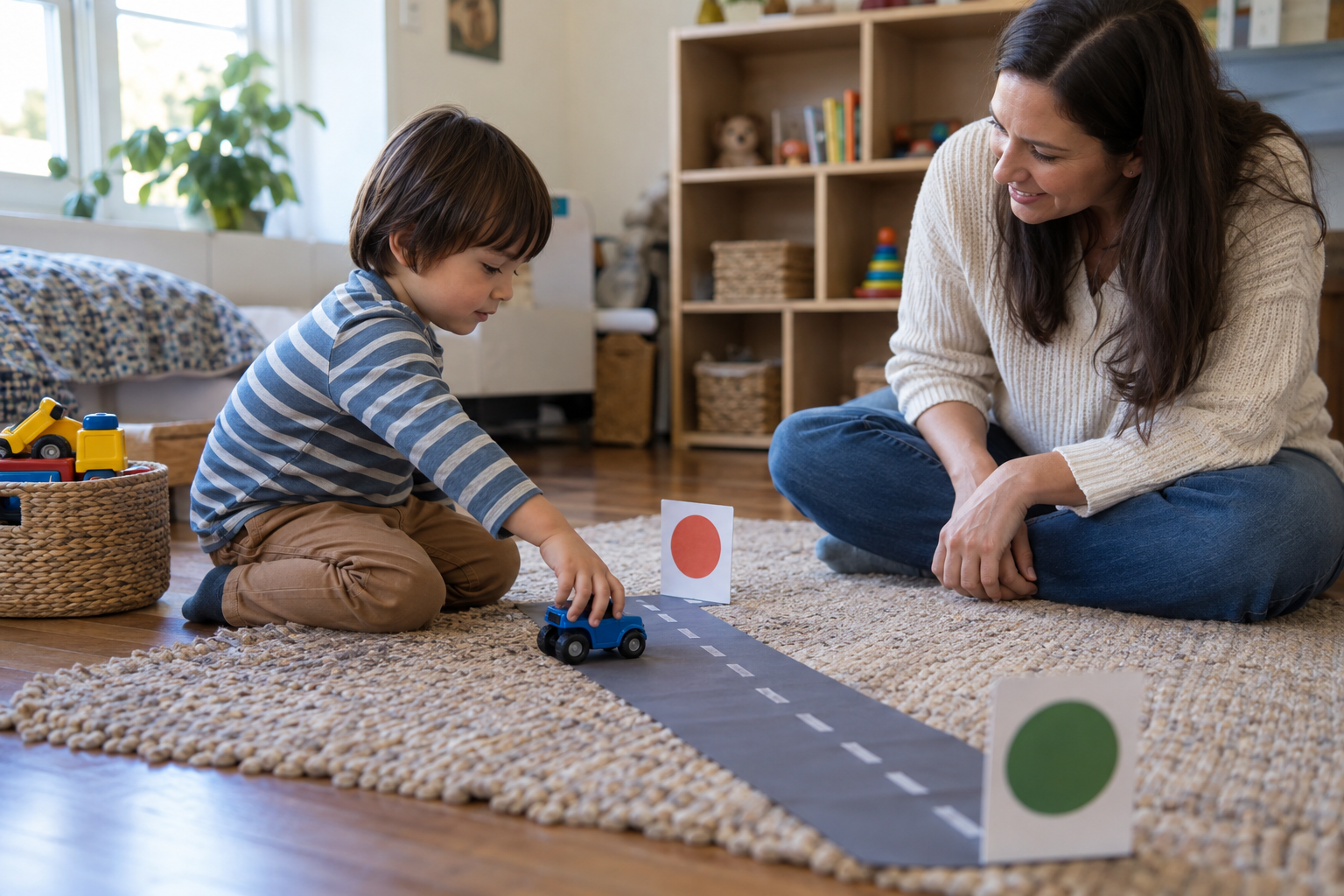
For example, we might initially teach a child to identify pictures of vehicles using structured trials. Later, while playing with toy cars, we can ask the child to identify different vehicles or respond to naturally occurring opportunities [3][4]. The teaching becomes more closely connected to the child’s everyday experiences.
We might also use a natural activity to arrange a short series of discrete trials. While preparing a snack, we could present separate opportunities to identify a cup, request a utensil, or follow a simple direction. Each opportunity can have a clear instruction, response, and consequence while remaining connected to something meaningful.
The key is to select teaching methods based on the child’s needs and the skill being taught. Some skills benefit from repeated, carefully arranged trials. Others may be taught more effectively through play, routines, and naturally occurring opportunities [3][4]. Often, the most useful plan includes both structured teaching and practice in natural settings [3][4].
Be Clear About What the Data Mean
Because DTT involves identifiable trials, it can provide useful information about learning. But the data are only meaningful when we know what each trial represents.
Did the child respond independently or with a prompt? Was the instruction presented as planned? Were the materials appropriate? Did the child have enough time to respond? Was the consequence delivered consistently? Were there changes in the environment that may have affected performance?
These questions do not mean that every teaching opportunity needs a complicated record. They do mean that data should match the teaching procedure. If we record a response without noting that it was prompted, we may overestimate independence. If we combine different targets under one code, we may not know what the child has actually learned.
Accurate information helps us decide whether to continue teaching, change the prompt, vary the materials, practice generalization, or move toward maintenance.
The Goal Is Learning, Not Completing Trials
I want therapists to understand discrete trial training, but I do not want them to become so focused on counting trials that they lose sight of the child. The purpose of DTT is not to complete ten trials because the data sheet says ten. The purpose is to create effective opportunities for learning.
Sometimes that means presenting several trials in quick succession. Sometimes it means spreading them throughout the day, changing materials, or adjusting the teaching arrangement. We should always be paying attention to the child’s engagement and performance.
Once you understand what makes a trial discrete, the method becomes much easier to recognize and use. It is not about the table, the flashcards, or the number of trials.
It is about arranging clear opportunities for children to learn and helping them become increasingly independent.
References
[1] Smith, T. (2001). Discrete trial training in the treatment of autism. Focus on Autism and Other Developmental Disabilities, 16(2), 86–92. [https://doi.org/10.1177/108835760101600204] [2] Cooper, J. O., Heron, T. E., & Heward, W. L. (2020). Applied Behavior Analysis (3rd ed.). Pearson. [https://www.pearson.com/en-us/subject-catalog/p/applied-behavior-analysis/P200000001665]
[3] Yanchik, A., Vietze, P., & Lax, L. E. (2024). The effects of discrete trial and natural environment teaching on adaptive behavior in toddlers with autism spectrum disorder. American Journal on Intellectual and Developmental Disabilities, 129(4), 263–278. [https://doi.org/10.1352/1944-7558-129.4.263]
[4] Shire, S. (2024). The devil is in the details: Advancing our collective understanding of naturalistic developmental behavioral interventions. Autism Research, 17(1), 10–16. [https://doi.org/10.1002/aur.3048]